Sanil Electric has grown on the back of a shortage of transformer capacity and an investment boom in data centers, renewable energy, and storage systems. Revenue and earnings continue to grow at double-digit rates, and production is running at full capacity. The business, however, depends heavily on a few large customers and on how long the current industry cycle lasts. Let’s take a look at what is driving the company’s results, where its strengths lie, and which risks could change the picture.
Business
Sanil Electric is a South Korean company that manufactures transformers and reactors to customers’ technical specifications; these products account for 98.1% of revenue. The equipment is used in power grids, renewable energy, energy storage systems, data centers, and industrial facilities. Sales are made primarily directly to large industrial and energy customers.
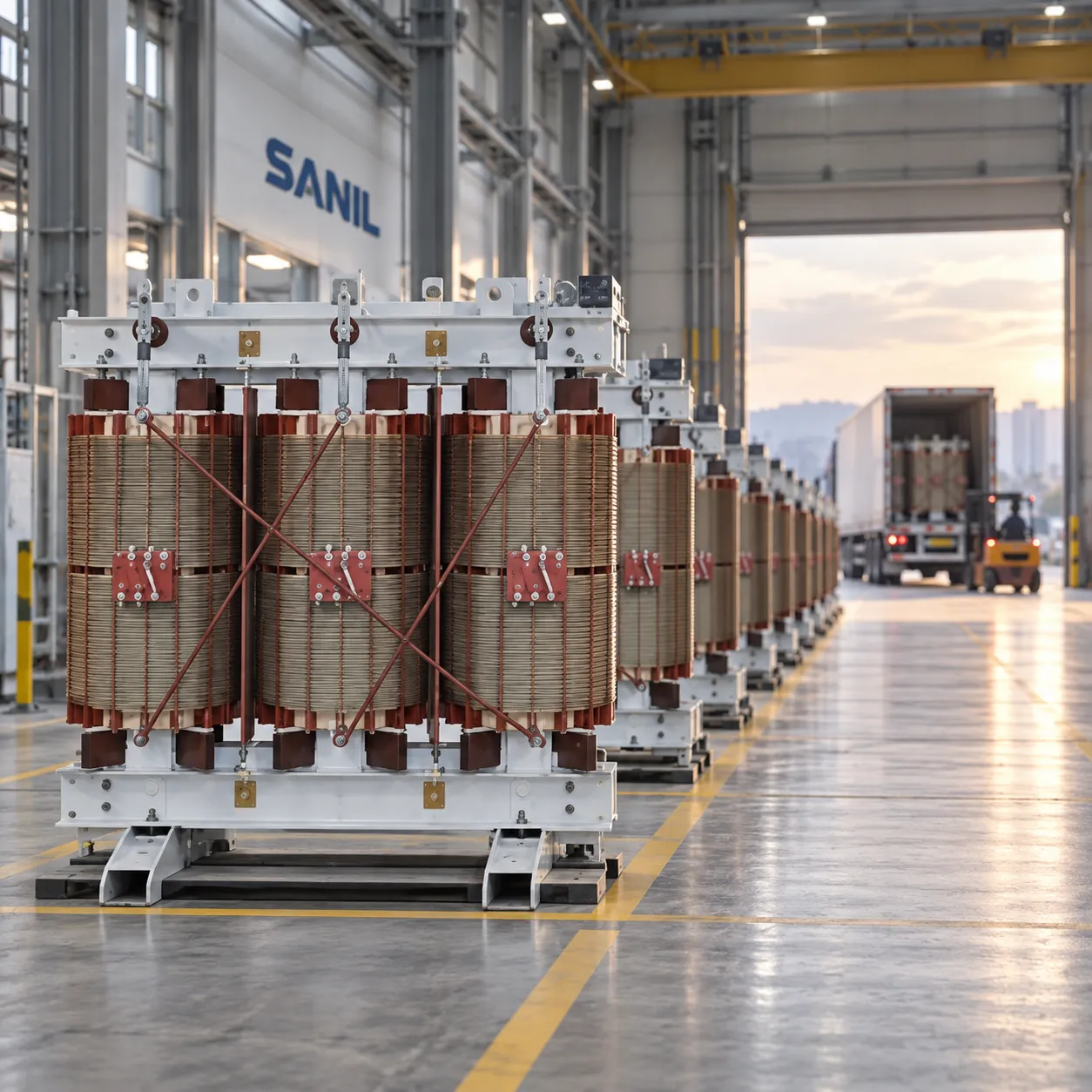
The economics of the business are driven by order volumes, capacity utilization, and the contract mix. Most sales now come from more complex transformers for data centers, renewable energy, and energy storage systems (ESS). This equipment requires significant technical expertise, and each project demands reliability and adaptation to specific conditions, making it more difficult for customers to switch suppliers. Another advantage is the company’s long-standing relationships with large customers.
Price: 204,000 KRW
Position size: 5% of portfolio
Position risk: 44.6%
Portfolio risk: 2.2%
Relative strength: medium
Trend: upward
Comparable publicly traded transformer manufacturers include Croatia’s KONČAR D&ST and Turkey’s ASTOR Enerji. The industry, however, is currently operating in a high-demand, supply-constrained environment, making it difficult to fully separate the company’s own quality from the effects of a favorable market cycle.
Key metrics
- Revenue in the first half of 2026: 314.5 billion KRW versus 227.1 billion a year earlier, up 38.5%. TTM revenue reached approximately 589 billion KRW, compared with 502 billion for the full year 2025.
- Operating margin: 37.9% in Q2, compared with 35.6% for 2025 and 32.7% for 2024. Profit growth continues to outpace revenue growth, supported by high capacity utilization and the order mix.
- New orders: 422.5 billion KRW in the first half, with a book-to-bill ratio of 1.34x — for every 1 KRW of current revenue, the company received 1.34 KRW of new orders. Backlog at the end of the period was 556.8 billion KRW, equivalent to almost a year of current revenue.
- Production capacity: 44,133 units per year versus 35,431 in 2025. Utilization is 87.2%. New capacity is being absorbed quickly by current demand; expansion has not yet been accompanied by a noticeable decline in utilization.
- Renewable / Data center / ESS: 80.6% of Q2 revenue. Sales in this group grew 51.7% year over year, while revenue from the power grid segment declined 30.6%. The company’s growth increasingly depends on data centers, renewable energy, and energy storage systems.
- Operating cash flow (TTM): 187.6 billion KRW, compared with net income of 180.3 billion. Cash conversion recovered after a weak 2024. Reported FCF over the last 12 months is around 173 billion KRW.
- Balance sheet: virtually no bank debt. As of June 30, cash amounted to 95.1 billion KRW, and together with short-term financial assets, liquid assets reached approximately 216 billion KRW. Current assets were more than five times current liabilities.
Main risks
- Four large customers account for 89.5% of revenue, with the largest alone accounting for 32.1%. The loss of one such contract could simultaneously reduce revenue, factory utilization, and margins. Long-standing customer relationships reduce this risk, but do not eliminate it.
- The U.S. market generates around 87% of sales. Meanwhile, more than 80% of quarterly revenue comes from Renewable / Data center / ESS. The result is high geographic and industry concentration.
- Current profitability reflects an exceptionally strong industry cycle. Comparable manufacturers are also reporting high margins: KONČAR D&ST reported an operating margin of 32.9% for 2025, while ASTOR Enerji, despite a 17% increase in physical output of distribution transformers, reported an approximately 18% decline in realized price per MVA. As industry capacity expands, price competition may gradually return.
- The new growth phase requires substantial capital. At the end of the first half, around 18 billion KRW of previously planned investment remained, and in August the company signed an agreement to acquire property worth 69.25 billion KRW for the production of ultra-high-voltage transformers and the expansion of existing capacity. Most of the cash outlays are still ahead. The high FCF of the last 12 months cannot be treated entirely as free cash flow available for distribution while production expansion continues.
Important details
- In 2024, net income was 83.7 billion KRW, but operating cash flow was only 15.5 billion, and FCF was negative at 74.2 billion KRW. The reason was a sharp increase in accounts receivable and inventories, as well as investments of almost 90 billion KRW. Cash conversion later recovered, but Sanil’s growth clearly requires significant working capital and production investment.
- There are still 527.6 thousand unexercised options with an exercise price of 3,344 KRW — around 1.7% of the current share count. At the current market price, the options are deep in the money, and the potential dilution should be taken into account.
- In January, the company invested 29.5 billion KRW in a private-equity fund, accounting for 66.5% of the fund’s capital. This amount does not materially affect financial stability, but it is the most notable use of funds outside the core transformer business.
Fundamental status
- The company’s position can be considered stable. Growth in order volume and a substantial backlog provide a solid foundation for further expansion. The company maintains high margins, has restored cash conversion, and has virtually no bank debt.
- Still, the business fundamentals have clear vulnerabilities: high concentration among key customers and in specific markets, as well as the risk that industry profitability will normalize as the shortage of transformer capacity eases.
What to monitor
- Book-to-bill and backlog. New orders should at least match current revenue. If book-to-bill falls below one for several consecutive quarters, it would signal that the order book has begun to shrink.
- Operating margin. The key reference point is whether it remains above ~30%. A sustained drop below this level would be the first serious sign of price normalization, deterioration in the sales mix, or negative operating leverage.
- New capacity. The key question is whether high utilization is maintained after the factory expansion and whether the return on new capital exceeds 25% once production reaches a normal operating level.
- Cash conversion. Operating cash flow should continue to track profit. A decline in CFO below 60% of net income amid another increase in working capital would be a negative signal.
- Large customers. Watch for any significant loss of orders from the largest buyers and, ideally, for a gradual reduction in dependence on a few counterparties — without sacrificing margins.
Sources
Sanil Electric — 2Q 2026 Earnings release / IR materials
Financial Supervisory Service DART — Sanil Electric periodic filings
Sanil Electric — FY2025 IR Book
NREL Report — Distribution transformer demand
ASTOR Enerji — 2025 Annual operating review
KRX market data via Naver Securities — Sanil Electric quotation
Vladimir Vereshchak — investment advisor
How I work →
Email ·
Telegram ·
LinkedIn ↗